
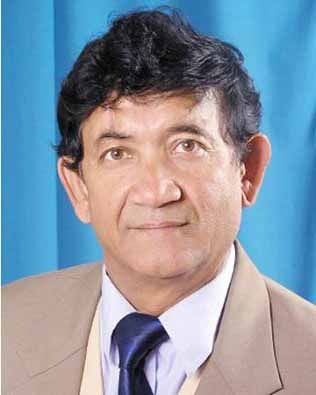

[LB Chhetri is a Nepali poet and storywriter. His fame as a writer rests in his three publications: two short story collections: Trishankuko Deshma and Indramayako Deshma, and a collection of poems: Bheedma Harayeko Manchhe. Also the editor of Charaibeti, a literary magazine, Mr. Chhetri is the Chairperson of Kavidanda Sahitya Samaj, a literary organization based in Chitawan. Mr. Chhetri leads a dynamic life with experiences borrowed down from an amalgamation of his military and academic life, anchored now by literary engagements. Presented herewith is the edited excerpt of an interview Uday Adhikari of The Gorkha Times had with Mr. Chhetri. ]
How did you get into reading?
Interesting, Wonderful beginning. There are two phases Uday. I started reading Hindi magazines from my early childhood. I went crazy to read Chanda Mama, some film magazines, or even before that, I had started reading some cartoons and Banmanus Nakabposh in Hindi daily ‘Aaj’ published from Banaras. Say, I was 8/ 9 years then. By the time I turned 12/13 I loved reading Hindi commercial novels of Ibnesafi BA, Gurudatta, Gulshan Nanda and many. I used to read Dharmayug, Sarita also. By the time I was reaching 14/ 15 say nearing SLC examination I had stepped to reading Acharya Chatursen, Prem Chand, Devaki Nandan Khatri etc. If you ask me to name a few books – Lal Rekha, Wayam Rakshaamah, Godan, Nirmala, Chandrakanta etc etc.
The second phase is English reading. I am neither an English background nor an English boarding school product. I started A B C D of English from class six only. I was a good student say among top five. In 1965 I cleared the High School examination, and in Oct 1967, I joined the Indian Armed Force Regiment of Artillery as a clerk. While at Army Clerks Training College Aurangabad I picked up Dennis Robins’ romantic novels from the library but I could not enjoy. There was a soldier clerk student in my squad ,an English school product, who read English novels. He used to read-only English novels. I borrowed a book from him- 79 Park Avenue, a romantic adventure by Herold Robins. This is the first English novel I read completely. In 1971 Jun or July we were involved in India- Pakistan war situation and remained most of the time in India-Bangladesh(then East Pakistan) borderline area. (War Thrilling was there, but mostly it was sort of loiters life for me. I felt aloofness and monotony as most of the time troops were away. I remember to have bought Carpet Beggar by Herald Robins from Siliguri Railway station and having no stress of work then, I started reading and enjoyed it fully. I must confess while reading the novel, sentences were no a problem but the words I had to fight with to comprehend meaning and the sense. I bought Advanced Learner Dictionary. Continued with the pages of the novel, underlined the difficult words and then traced meaning and then read the pages after pages like this only. I enjoyed reading, increased vocabulary, but it was time taking and sort of trouble taking process. A novel was to be read undisturbed and unchecked to enjoy it fully. Still, I underlined the difficult and unfamiliar words but do not refer dictionary unless totally harassed for want of meaning.
Ah ! I ran after the words, the lines and the paragraphs and turned pages after pages without worrying the unfamiliar words and I got lost into reading to the extent that I either forgot or took in hurry my breakfast, lunch or even delayed dinner. But reading had no option and reading Herald Robins became sort of a passion. I kept reading and reading one after another novels of Herald Robins and also of other writers such as Irving Vallance, Jacklin Susan, A handsome amount of my salary went for purchasing books. I started loving fiction characters without knowing the art of characterization, I loved story without knowing what the plot was. Likewise, I gradually became familiar with situation, color, atmosphere, flashback and this and that of novel writing craftsmanship. I say, familiar not expert.
My taste of reading shifted from commercial to literary works when I encountered with Thomas Hardy’s Mayor Of The Caster Bridge. But once I started reading GB Shaws’ plays, my interest shifted to plays from Novels. The first being Candida and then after many, such as Arms and the man, Pygmalion, Major Barbara etc etc. I also read Shakespeare’s As you like it, Macbeth and Henry Ibsen’s A Dolls House, Ghost and many. Then I was doing Bachelor course from Rajasthan University Jaipur the year being 1983.
I got fascinated by literary novels and read DHL’s ‘Sons and lovers’, Daniel Defoe’sMoll Flanders’, Jane Austen’s Emma, Irish Murdock’s ‘The Bell’, ‘A portrait of a Artist as a young man by James Joyce. Then I was doing my Masters in English from Patna University. I was 35.
Mostly retired Army personnel are, after retirement, involved in non-academic professions. But you are different. If you continued you could have retired as an Army officer with a handsome pension. But you chose early retirement.
My dream haunted me and I had no option. I could never say No to my dream. Let me narrate you this way Uday. Once a Captain visited my office in a tent and found my book ‘Carpet Beggar’ lying on my office table. It was 1971 July or August. I was in Langar for breakfast. When I entered the tent office I found Captain sitting on a chair and reading my book. Seeing me he went straight – you must apply for ACC or NDA. I saluted him and said ‘thank you Sir’ and smiled. One more similar situation Uday I would like to narrate here. In 1984, the year I completed my graduation from Raj University, I had applied for premature retirement and the officers of my Battery knew it. One Captain had once commented, “I don’t understand what makes you to go home so early Lal? You deserve to be an officer, and you should have better applied for PCSL instead of applying for premature retirement. You could retire at least a Colonel” And I was prompt “Of course I am going to be an officer Captain Sahab but not in Army. I am going to be a University Professor.”
I was not satisfied with what my father was or with my family standard then. I dreamt more and dreamt honorable. I remember one incident. I was student of class XI B(B for Biology). Son of Tahasildaar and me were good friends. Once a newly admitted student , a Muslim boy, a powerful municipality engineer’s brother extended his hand for friendship and we welcomed him in our group. On a Sunday we planned to go for swimming. Shaukat was to come to Rajendra and then they to me. As a student, he was intelligent and always showed his presence in the class room wearing expensive dresses and argument with the biology teacher in the class. During Tiffin he asked me what my father did. I informed him briskly ‘a Security Guard’ in SBI. I could read an array of disappointment on his face. Perhaps he hoped an accountant or a Branch Manager. On Sunday they did not come to my house but went for swimming together. Next day I remained silent for long. In the Tiffin time Rajendra said, “Sorry, we couldn’t come yesterday “. I said nothing but it’s ok”. I think the pang of such segregation survived in me for long without my knowledge. Today I am happy that my children do not suffer my experience whenever they are asked what their father is.
I wanted to exclude myself from Lahure image. And for that taking risk had no option.
But you began your career as a teacher before joining the Indian Army. Will you please share some experience here?
Answer- Yes, I did. Against my hope and expectation, I did not do well in SLC result and was third division. But then, I was an ambitious boy and wished to study biology. As a student I always remained among the top five. In class six I was topper and was third in class eight. Because of my good record, principal permitted me to join I.Sc. Biology. My first mistake. Higher Education then in 1966 was not a joke. Family support, inspiration and encouragements play vital role to shape a lad of my stratum and his career. My mother and two brothers had shifted to Chitwan in the end of BS 2022. I was with my father studying I.Sc and used to cook, wash and clean and then go to college: King George Silver Jubilee Inter College, Rasara, Ballia. My father woke me up early in the morning and asked to go for running. I thought he cared about my health, he thought how to make me strong enough in running so that it would be easier for my selection in Army. We were always in debate. I said I wanted to read medical to become a doctor. Father retorted “Impossible, you can’t dream of that “.My father defended himself with the argument” we couldn’t “. I did not appear in class XI final examination rather saying goodbye to my regular study joined my mother and brothers in Chitwan. My father was happy. Mother had no idea whether to be happy or aggrieved.
It was March 1966.
SLC was a good qualification in Nepal then and Lower secondary school from nearby my village employed me as a teacher. At the age of 16, I was younger than a few students of class seven and eight. Pushkar Ghimire, cousin of Madhav Ghimire was a class eight student then. I was a kid like for the headmaster. I worked in school for about a year and three months. To be very frank and honest, I did not enjoy teaching there. I had something else in mind; I didn’t know exactly what but perhaps more than that and always wished to be someone different from others. One day early in the morning, I put a shirt, a pant and my testimonials in a jhola (hanging bag) and without telling anyone in my family I reached Narayangarh. At Narayangarh, there were two directions one going to Kathmandu and another crossing river and heading towards Butwal. I had a MOHOR (fifty paise coin) in my trouser pocket. I tossed. It said west. First I thought of rejecting the verdict of toss and heading North, but then I smiled on my folly and crossed the river by a Dunga (wooden boat). I was going west that took everyone Butwal for the first half, the second being Gorakhpur( India).
Perhaps it was a day of BS 2042. I was playing volley ball at Kailash Nagar Primary School. You were standing nearby your cattle grazing grass. I noticed a play by GB Shaw in your hand. Do you recall the moment ?
Exactly I don’t remember the day, but I recall those days when most of the time a book, a pencil and a paper were my associates. I had no time to waste. I had, by then, resigned from Army and joined Master Classes at Patna University. My wife and four kids were financially dependent on me. Resigning from Army service and joining University was sort of a risk for a 35 year bloke, a husband and father of four kids. If I failed in examination my hope would die. There was no back paper system in Patna University tjen I don’t know what now. I had no option but to pass the examination at first go only. I had to work hard. I enjoyed wrestling with giant writers like GB Shaw or Henry Ibsen or Thomas Hardy or TS Eliot and so many with passion and compulsion both. To pass the examination was a must for me. Secondly, it was not my intention just to pass the examination but to learn also. In fact, I enjoyed reading and reading only. So, you must have found GB Shaw, me and cattle together at cultivable fields turned grazing spots .
What made you chose English as your major?
Initially I was interested in science and was studying Biology dreaming a doctor. But circumstances did not come to my favor and I have said above what happened then after. Later, when I loved reading English Novels, I loved English as a subject as well. I was a clerk in Army and our medium of correspondence was English that too helped me to love English as a subject.
I had passed SLC in 1965, and it took me 15 long years to go for Intermediate level Examination, I.A. While selecting subjects I looked for easier ones and went for English Literature, Hindi Literature and compulsory English. Then for two other subjects I chose History and Sociology.
I loved and enjoyed English literature more than other subjects.
After SLC you began a career of a teacher in a primary school. For many, it was a good settlement, but I imagine something might have been cooking in you. You left the job and headed towards India. Your decision changed your life forever. I wonder what led you to leave a very respectable job for an uncertain future.
That was not my choice but. Due to several factors I couldn’t continue my higher education i.e. ISc. Biology and joined my mother and brothers here in Chitwan in early 1966. I was just 16 years old then. When life starts catching speed during any one’s early age, I call it struggle period, it meets several turning points. Sometimes life is shaped by when, where and how you take turn. I am often asked if I have any regression in life. Being a teacher of a Primary School during BS 2023/24 at the age of 16/17 can’t be a good settlement for anybody. I had a holy obligation to myself and ensure my whole life doesn’t go waste. I do not mean to underestimate the primary school job, but it is but natural for a young man of my age to dream and create a dream. I was a dreamer and ambitious of course. I do not regret to have left that primary school job but certainly regret why I didn’t choose the road not taken, I mean North?
Then I did not know what was in the North or say I had no idea but now I know. In the North was the Capital, Kathmandu, the whole Nepal. I was indeed looking for a future, I should have found my future in better shape in in the land of my country. And may be, I should have got the opportunity to meet Bp Koirala, Bhupi serchen, Parijat etc.
Do you remember a poem “The Road Not Taken” by Robert Frost?
Then took the other, as just as fair,
and having perhaps the better claim,
because it was grassy and wanted wear;
though as for that the passing therehad worn them really about the same.
Why do you have such indifference to politics ? don’t you like politics ?
No, not at all. When I was President NUTA Birendra Campus I was nominated member of Congress District Committee. All rubbish. No one listened to me. They said, “You will not understand these things” And really I never understood those things of politics. Let me narrate you one example why I didn’t understand those political issues. During BS 2061 to 2064, I was Campus Chief of Birendra Campus. To be gheraoed by the political brother organization students was a normal process. Once a student hit me on my head. The next day Human right leaders came to interview me. I told the fact. Next day I read their report in local news paper . They did not utter a single word about the violence taken place in Campus Chief Office. I reported the matter to the police, got medically examined and the next day went to CDO office. CDO Saab promised to arrest the culprit within 30 days. He even phoned the SP before me. The political party leaders of that violent boy’s camp gathered more than seven times and asked me to withdraw my police complaint but I didn’t. One of my close friend kept insisting them ‘let the culprit be arrested at least for a day to discard such devil instances’ but they were sorry to let that happen. Poor CDO failed to fulfill his promise. There are several such anti discipline instances I abhor. I have seen politics very closely Uday. There is no question of joining this law making institution in a country where law has no respect at all. Not at all.
While discussing the importance of Nukkad, Ramlila Maidan and short street performances you told me once that you used to play various roles also. While narrating that your face beamed with excitement. Would you like to share your childhood memory with us?
Yes, I was brought up in a street corner’s Nukkad culture. These also must have played some roles in shaping me up. In India, SBI had allocated us a house of only one room. Use it as a bed room or a kitchen, a drawing-room, a storeroom, Rodi ghar and also a Juwa Ghar. It was attached to the big SBI building where my father performed 8 hours a day a security guard’s duty. From our one room house there emerged several Gullies. In one minute one could reach one Gully (street).
I had many friends. I visited their houses very often. I never compared my room to their houses. I loved my one room home and enjoyed streets and Nukkad company. I was a dreamer but. Two things are important to mention here. During those days( 1960), roaming seasonal theatres used to arrive and showed dramas (then males played the role of female characters), and every summer, Ramayana and Mahabharat were recited by expert Pandits. I was crazy for both. I remember to have watched then Sultana Daku, Raja Bharthari, Jai Shiva Shanker, Laila Majanu and many. And I also listened to the Mahabharata, Krishna Charitra and Ramayana every year. The Pandit who recited these holy stories was not less than a dramatist himself who not only recited but sang, played Harmonia and acted some times. Ah ! This is how I was introduced to the great epics Ramayana and Mahabharata.
When I was a student of class eight, 1963, I formed a group of boys and girls and began performing drama. During day time, I called the boys and girls for rehearsal and directed them. Those big drawing-room family friends Prabhat, Pradumna, Nawal, Shambu also joined my group. We performed Sultana Daku and I myself played the main role of Sultana and Prabhata played Inspector Young. Prabhat had provided us his Barandah for performance and his drawing-room was for makeup and actors room. We gave several hit shows as we collected two rupees from our first performance. The ticket rate was ok aanaa (one Ana say four paise).
Whenever you speak, you create a dramatic sensation. You always seem to be a character straight from Shakespearean theatre. Your intonation, your action, your gesture seem to have been copied from Shakespearean tragic heroes who always think they do no wrong. Do you think your behavior has been greatly impressed by the life of Macbeth, Othello, Hamlet, and King Lear, whom you taught obsessively for more than 15 years? You taught me Macbeth and I always felt one Macbeth was talking of another Macbeth.
I take it as a wonderful complement. It is up to you guys to notice, guess or read about me and my style. I have been telling it in the class– style is the man. Well, I loved Drama since my childhood. I have spoken on this above and elsewhere too that I listened to Ramayana and Mahabharata or Krishna Charitra since my childhood. I enjoyed these great Hindu religious epics but not as a religious scripture but great Dreams. When I began my second inning of education after a gap of 15 years, I became a great admirer of Shakespeare, Shaw and Henry Ibsen and also of Greek playwright Sophocles. I also enjoyed reading plays of William Tennessee, W Singe and Ravindra Nath Tagore. Talking about my teaching life, I was perhaps typical in the sense while discussing the characters in the classroom, I behaved as if I myself was Lear, Macbeth or Othello. In other words, these characters were mixed in my soul. For a while they got into me and I was the characters performing on the stage. After a long experience of that practice in the classroom may be while talking to you people in private I appear so.
Once you said when you joined Army your height was very short . How did you join then ?That’s very interesting Uday. After leaving Dhanauji school job of a Pra Vi teacher I reached Gorakhpur. Then after? It was dark in fact. I had no idea. At Gorakhpur Railway station I found a group of Nepali boys carrying bags on their back and bargaining with Riksha Wala to go somewhere. I asked one of the boys where they came from, where they were going to and why. The boy spoke just two words- Kunaghat Bhartihuna. I kept watching them getting into the rikshas six, seven and eight and nine even ten or more rikshaz ran east. Things were clear to me. The young and chubby boys were brought from Nepal by a Gallawala to get the boys enlisted in the Indian Armed forces. I kept watching the last rikshaw disappearing from my sight. It was morning time say 6/7. The red sun peeped through the dense trees and spread on my face. First I blinked and then smiled. I remembered once my father had taken me to the place. He used to draw his pension from there. Then I was thirteen years old, had passed my class eight examination and was going with father my ancient village Samdhikhola. At Kunraghat, my father had briskly told me “I was enrolled from here and had gone to fight second word war” I remember the year -1963. Even month- May. Date? no idea.
I also bargained a riksha and reached Kunraghaat. It was about eight in the morning. I feared entering the gate as two smartly dressed up Gorkha Rifle soldiers set in big Gorkha hats were standing straight. I took out my English Grammar book from the bag, carried in my right hand and feigning no fear I entered the big GRD gate. I did not look at them, and without their objection, I headed towards the measuring side. I saw hundreds of young Nepali lads in Kattu only, standing and roaming here and there with their brisk faces, muscle thighs and round arms. There were standing so many Gallawalas, parents, pensioners (men and women), a few JCOs also. The Kattu boys amused with happiness and were enthusiastic, having sort of ablaze on their faces speaking of great achievement.
One JCO shouted asking the standing boys to make two queues one Galla group and another Parent group. There was not a call for me and me like. No Galla group no Parent group. Parent group means the ex or serving soldiers were also allowed to bring their sons. For a moment I thought to go to Rasara and bring my father. But the very next moment I dropped the idea. I took out my shirt and pant and stood among Parent group boys. It was a romantic scene; a soldier was measuring height, another chest and the third one was taking weight and one soldier was carrying a mug of red watercolor in one hand and a wooden thick brush in another scrawling on each nude chest. When my turn came the soldier measuring my height said loudly 5.6( that meant height 5 feet 6 inches) another said 29-32( Meant normal chest 29 inch and with breath 32). The weight taking soldier said loudly 47 (meant 47 KG). And the soldier with color and brush wrote on my chest in red watercolor ht 5.6/chest 29-32/wt 47 and then underlined all and below he wrote in bold UNFIT.
Did that close the chapter? No!
I put on my shirt and pant and again carrying the English Grammar book in one hand and hanging the small cloth bag on my left shoulder I moved towards the main gate. This time I preferred to walk through the front. I was interested in the beautiful garden in front of the Quarter Guard that I had glimpsed while entering GRD through rear.
It was about 9.30 or plus, time for Commanding Officer’s arrival. I had no idea about their formal ceremony. My eyes stuck at the beautiful building of Quarter Guard, soldiers standing in queue with arms in dressed up in beautiful green uniform, on their head Gorkha Hat. That was a wonderful romantic scene. I heard someone shouting ‘Guards SAVADHAAN’ or Guard Alert and all soldiers came to attention in one boot sound THAK. Two bugle men soldiers played a DHUN (tone Titer Titer Titer). One jeep car came and stopped in front of the quarter guard. One tall and healthy man in green uniform got down of the jeep and stood there. The jeep left. He was given Arms salute called SALAMI SASHTRA and then he was taken to inspect the guards. It was an excellent ceremonial parade. Till then, I was standing by the office wall and thinking that the ceremony was over started walking on the road to exit through the main gate. One solder rushed towards me and pushed me toward the office verandah. The Guard of Honor show was not yet over perhaps. When he pushed me I fell on the floor and my book dropped and sliding on the floor slipped into the office and my bag took shelter at another corner. The action hurt my hip and both hand palms because I might have thrust my hands on the floor. I got up but did not move until the Colonel left Quarter Guard. Then I picked up my bag and looked inside the office to search my book. Someone was on a chair. He was a Nepali, a Gurung, a Major in uniform. He asked me in Nepali – ‘key khojeko’ (what are you looking for?’).
I was humble – ‘my book sir.’
He pointed on the table and said – Is that yours?
‘Yes Sir,’ I said.
‘Take that.’ He permitted.
When I was picking my book from his table, I do not know why or how, but my eyes were wet. I said ‘Thank you sir’ this time in English. He could guess my throat was chocking.
‘What happened?’ he asked
‘I want to join Army. I am Metric pass.’ I had put emphasis on Metric with pride and standing erect, I showed my confidence too.
‘So?’ He looked at me.
‘I have no body with me. No galla’. I did not say no parent.
‘So?’ Relaxing on his chair he seemed curious and was smiling.
‘This happened’ I opened the buttons of my shirt and showed my chest written UNFIT in bold.
He came out in the Verandah and read in sunlight my physical strength of 1967- 47 Kg. Major Gurung asked his peon to bring water and a towel and asked me to cleanse my chest. He sent his peon to call one of the measuring soldiers and the painter with measuring equipment. They brought everything there in his office and I was re-measured. When the soldier said 29-32 Major said ‘write 31- 34’, the painter wrote chest 31-34, weight 47 Major commanded ‘write 51’, painter wrote 51, height 5.6 that was OK. Major Gurung then asked his peon to call George Babu(clerk). George came and Major Gurung instructed him in English thus – ‘Complete this boy’s document within an hour and send him for medical immediately. Tell Captain Kapoor I have sent him. I want his Ex-ray report by today evening. Any doubt?’
‘No doubt Sir’ he saluted, looked at me and said ‘mere sath aao’ (follow me). I folded my hands to Major Gurung for namaskar and followed George Babu. I was declared medically and Ex-Ray fit within two hours. In the evening my further documents were completed and sent to quartermaster to draw Dari, blanket, Mistin, spoon, mug, and one more thing perhaps- a knife. I was sent to barber and my Dev Anand cut long hair turned into Dara Singh cut. I did not feel sorry when the measuring soldier had rejected me of the quarter guard soldier had pushed me towards the office corridor but when the barrack in charge Naik Ram Bahadur Thapa rejected my plea of allowing me to have my hair I was hurt.
I do not know where does lie the key of one’s destiny chapter but I believe in Chance call it FATE or BHAGYA or DESTINI. I was enrolled as ORA (Operator Radio Artillery) in Regiment of Artillery and had become part of the Indian Armed Forces. It was 20 Oct 1967, BS 2025, Kartic
You compose poems in Nepali and English. Your parents were fond of Rodhi, a type of a culture where a boy and girl compete through songs that doesn’t last unless one party accepts defeat. Somewhere else, you mentioned you were fond of your father’s recital of Mahabharat and Ramayana. Do you think your parents’ involvement in cultural programs like Rodhi and Dohori (A completion in duet song) and your father’s recital of famous epic like Mahabharat and Ramayan helped grow a poet in you?
Poetry was there in my home atmosphere. I was born in India, grew in India and got all education in India at various stages. My father was employed as a SBI security guard a reputed post among Nepali people of Rasara, Balia or the surrounding towns. Many Nepali people visited our house to meet my father. I remember even some congress political men from Varanasi and Gorakhpur too used to visit our house in Rasara, take food and talk to my father. But here let’s concentrate on me and a poet in me. Since my very childhood I was introduced to poetry. The Nepali people sometimes alone sometimes with family from Rasara, Balia, Mau and Beltharaarod nearby towns surrounding Rasara often visited our house. In a way they considered my father a leader. But I must confess such gathering was for Rodhi, Dohari, Taas, Kauda and alcoholic. During day time they played RAMMI, in the evening drank Taadi and Local Tharra and as the night grew gradually Dohari began and I remember Gurungseni Saanima or Gurung Aunt, Belthaaa road Aunti, Daaiwarni Thuloma or Driver’s wife or elder Mother and also my mother formed a group and sang for hours and sometime whole night. I concede with your question-cum-statement that poetry must have found a place in my heart in very early age with the beautiful words and sonorous tone and tune. I regret not to have noted down those lines then. The child lb then couldn’t foresee one day he would be asked how he loves poetry. I still remember a few line such as “Ma Timro hoinara nirimaya thuli’, ‘ salko pata tipera paani khaaun’. like folk songs.
Did you compose poem then?
Yes I did. Not in Nepali . The first poem ever I composed was in Hindi. During my school days, I used to compose poems in Hindi and send to local newspapers then. One poem I remember was for a girl studying in class eight and me in class ten. She was a Nepali girl and I liked her most. That was totally innocent liking but. Next year she was engaged and got married and I composed a poem on her wedding day- Aaja meri khaasa ko dur par paas ko koi lejaayega or Today, some one will take my beloved far from me , still have that page safe with me. Can you imagine that page lives with me for more than 55 years now.
Many years back, when I was a student of university, you invited me to present a paper on The Waste Land, I must confess it was the first paper I’d ever read informal program and the credit solely goes to you. Along with paper presentation, there was a performance of Macbeth and you were the director. In those days staging drama outside Kathmandu was very rare and performance in English was out of question. After that you directed other famous plays like Pygmalion, King Lear, Othello, Oedipus Rex and a few more. Even today you are excited to stage one of the dramas by Shakespeare. Would you like to tell what factor motivates you to involve in stage performance?
Learning and desire never end. As a teacher at Birendra Campus I always wanted to do something creative. Being a student of literature, I wanted to pull my students out of text books. So, I suggested the Chairman English Department to organize the programs on paper writings, poetry composition and drama performances. Actually, I was interested in involving students in such activities. Such acts, activities and actions would improve the students I believed. I was interested in Seminars and workshops, so almost every year, we conducted creative works along with drama performances. Sridhar Lohani, Durga Bhandari, Abhi Subedi, Padam Devkota and many talents from Central Department Kirtipur were invited and academic programs were held. The first-ever English play performed in Chitwan was, most perhaps, ‘The Death Trap’ by Saki. It was performed by the students of Balkumari College . It was performed at Narayani Kala Mandir and was a great success having two shows. Then I collected a group of interested students from I A Birendra Campus and directed ‘Pygmalion’ written by G B Shaw. It was performed at Birendra Campus big hall Room No .5. One who performed Doolittle is a well known writer today- Gopi Sapkota. Likewise, Macbeth, Othello, King Lear, Oedipus Rex were performed in Birendra Campus in successive years. The campus administration was indifferent, department sluggish but the students were full of enthusiasm, cooperative and very much active. One of the participants then in Othello was Deepak now known as Yug Pathak, the writer of ‘Urgent Ko Ghoda’. I think I am still a student and would like to be with the students. They have talent, and we should work on their talent to expose before the society. A few years ago I visited The United Kingdom and watched ‘Macbeth’ at Globe theatre. I have a great desire to collect interested students from Masters Classes and ask them to perform ‘Macbeth’ in a new dimension. But I am retired now and I have no say in B M C or any college. Alas! When the interests do not match things do not move.
For the last few years you have been visiting Europe and other parts of the world. Through Facebook wall post we have learned you visited Acropolis, Stratford and even Lake District. Being a student of English literature visiting these places for you must have been like a dream came true. How did you feel when you found yourself in the places you worshipped as a student of literature?
I was totally mesmerized Uday finding myself at Acropolis of Athens. It was on a rocky outcrop above the city. Ah ! the ancient buildings of great architecture lured me.
I love visiting world heritages and historical places but it’s a huge world Uday. You can’t reach everywhere. But fortunately I have been to a few though countable in figures. Let me share my experience of a few. I taught Shakespeare’s dramas for several years and being at Stratford and Globe Theatre, I felt as if I was meeting Shakespeare. Looking at his statues, I felt as if he was talking. At Lake District I imagined myself as child Wordsworth and stealing a boat I was running on the lake. Ram Mani Bartola and me while visiting District Lake were lost in BMC classes remembering the poem ‘Tintern Abey’. The same evening I composed a poem on Wordsworth “At Your Cottage William” that was published in Grey Sparrow, a journal published from Boston, America.
I am fond of your English poetry. Your responding pieces to WB Yeats’ The lamentation of the old pensioner’, a poem about a honeymooning couple in Pokhara are good pieces. Last year your poem appeared in a literary Journal along with Rita Dove, a famous American poet. You were very excited and convinced of what I had been saying about your poems. I wonder what took you so long to be convinced about your power in English.
Poets are born with natural ability, Uday. I am not a poet in that sense. Just getting a few poems published in some journals doesn’t make one a poet. I love poetry, and I know what poetry is, but just knowing what poetry is and loving poetry doesn’t make a poet. I scrawl a few lines or stanzas of poetry when a story or a plot strikes my imagination. It’s true when I appeared in Grey Sparrow as a honored guest with my first poem, “I Did Not Stop to Inquire More”, in July 2012 , I was immensely excited and did share with everyone, and I posted in facebook as my great achievement. I was there in Grey Sparrow and excited but did not consider myself a poet. I do not consider myself a poet. To be a true poet it demands true dedication and devotion. Writing a poem means knowledge and uses of structure and imagery properly to create technical excellence of a poem. The poem thus created should give deeper meaning. The key to composing a poem is making the audience feel. They are great creators Uday, often God-like. I must confess I lack this qualification. I think I am better at story writing rather than composing a poem. But then, I must thank you for considering me a poet.
You are a good short story writer. You don’t believe me until or unless someone with a big name repeats the same thing. You always follow the traditional pattern of story writing. Is not there any scope for experimentation ? Whenever you speak on fiction, you stick to plot, character, and other pattern. As a reader of English literature, you have seen James Joyce Virginia Woolf redrawing the line of fiction. I wonder what stops you from going beyond the traditional pattern of fiction.
It is not true Uday. I considered my stories worth reading when you considered me an accomplished one in story writing field. In fact it is you who first praised my story writing art. You openly praised my two stories “Prakriti” or Nature and “The Garden”. Gradually, I think the reader group also accepted me as a story writer. Till now I have three story collections published.
Lots of experimentation is going on in the story writing field in Nepal these days. I have always advised the young writers the need of reading and reading experienced writers such as BP, Mohan Raj Sharma, Parasu Pradhan, Manu Brajaki , Dhruva Chandra Gautam, Daulat Bikram Bista, parijat and many.
Reading them I have reached the conclusion that these genius story writers are fond of creating excellent plots from the real Nepali society. Plotless story writing is also going on these days as the writers work on psychoanalysis, self assertion meditational art but very less in number. Many of the Nepali stories, running without plot, seem running without direction, without structure. It becomes too much subjective and the story ends in ambiguity. It does not seem going anywhere. Plot is an organizational aspect every society should have. Our society runs, it seems, without organization. So some think why plot in a fiction. But to me it should be there. A fiction is replica of society and to me society should have a design, a pattern, a subject and as a whole an aim. These can only be interwoven through plots.
Many of your short stories are autobiographical. You seem to ease within the comfortable zone. How do you choose your subject matters?
Well, while writing a story, I give priority to the story first then work on the characters. And of course, I have several stories in me, with me and at me. And also I know without creating convincing characters story will not give its desired result. my characters are independent. In my fiction writing characterization plays vital role. Story to me means something that happens. Something that has happened in my life may create a story supporting my plot and encouraging my characters. Meanwhile I also look at my surroundings and question myself – can the happening with me make a good story to tell ? Once I am finished with my stories I am nowhere but the story and characters that represent society. It does not mean, Uday, looking for the comfortable zone. This is a more complicated task. Story writing is not an easy task thus. Yes, poetry writing is harder than story writing though. What you need is to understand the story’s fundamental framework. It means we ought to carefully plan structural moment so that an effect is attained. And you will not deny that my stories do leave an effect on readers.
Your many stories end in a O Henry’s style that gives a surprising ending. Devkota says a short story is a small window through which a small world is viewed or peered. Someone opines that a short story is a meal for one sitting. How do you define short story? Do you write short stories in one sitting?
You are invoking me to some extend. Generally it is said that a short story should be read in one sitting. Saying so does not mean the length alone Uday. The short story is a brief fictional prose narrative that is shorter than a novel that ends up with evoking a single effect on readers. So, reading it in one sitting defines that the reader may not enjoy the story (that includes art, technique and effect- call it unity of effect or impression) fully if he reads in more than one sitting. On the other hand, reading a novel may have a different technique. The better part of the novel is that the reader may end his reading once a chapter is over. Stories are not chapterised, let’s remember. It starts and then ends.
To me, a short story should be ‘short’ in many aspects, it’s not the length of a story alone, as I said above. The story should have minimum characters and limited plots. The characters are ready made and not developed. The action should be compressed one within a short time frame and space. It should deal with just one issue so that it draws readers’ utmost attention. However, I must confess that the story writers like Chekhov, James Joyce, Somerset Mangham and many have carved their own ways of writing stories violating several rules.
While teaching in different levels, I have encountered with some great story writers like Chekhov with ‘The Lady with the Dog’, James Joyce with ‘A Painful Case’, Rabindranath Tagore with ‘The Cabuliwallah’, Somerset Maugham with Mr. Know –All. They have, somehow, violated the rules of short story but these pieces are the brilliant examples of art. That is why Herbert Ellsworth Cory said. “The very technique of the short story is pathological, and titillates our nerves in our pathological moments.”
A good story writer besides all definitions looks for how to achieve depth or the feeling of depth in his creation. It’s a challenge for a story writer to be precise and look for depth creating the single effect. Among the four stories I mentioned above ‘Mr. Know All’ is near to perfection, in my opinion.
I do not write in one sitting. I make three or four re-readings before I stamp as ‘the end’. During my rereading, I ensure if my story has attained the effect I was working on. I also ensure if there is a depth that draws a philosophical line in my story of serious nature. It takes around a week or so for me to complete a story of around 1500 plus words.
Once I read your manuscript that compared Indramaya with Shaw’s Candida and Ibsen’s Nora. You extensively did research of BP Koirala, especially on his women characters. Probably the manuscript was the part of the PhD that you were pursuing then. What made you choose Indramaya from Teen Ghumti (Three Turnings) to pursue your ambitious project?
Above you asked why plot and characterization matter to me so much. I have reason for that and I am convinced with my reason. In my opinion, BP was more interested in creating characters than plots. I too put characterization above the plot creation. BP’s characters are not his spokesmen or mouthpieces , they are independent, say round characters as per E M Forster’s theory . BP’s most favorite characters are, in my opinion, Modi Ain and Indra Maya. To some extent Munaria of ‘Narendra Dai’ also. Someone was, once, arguing with me that BP’s most favorite woman character is Gauri. I said No. Gauri is rejection of BP. This I am adding here to let the readers know my understanding of a character in creative art.
I chose Indramaya as I consider her a rebel character. The rebel characters, specially women, are the need of Nepalese society. They are torchbearers. Indramayu could easily accept Pitamber’s condition and live a happy life instead she turned rebel, rejected her husband slamming the door on his face. This speaks a lot. She sets an extraordinary example of personal values in human life and no compromise with self dignity. In her fight with conformity, she is loud enough to make the society listen her.
BP was greatly influenced by Shaw and Ibsen, and most perhaps he wanted to create a counter character against Ibsen’s Nora and Shaw’s Candida. These three women characters ie Candida, Nora and Indramaya have spoken for self identity, women liberation and feminism from their writer’s perspective . I would like to mention here my ‘Indramaya Ko Deshma’, a proto type story where Nora and Candida are coming to Nepal to meet Indramayu. In fact, their search is peace and serenity in a world where materialism is dominant on relationship, whether domestic or public. The symbolic significance of this “Indramayako deshma” plot is to let the world know that two western world literary characters are coming to Nepal, a philosophical tree of peace zone, country of Lord Buddha to learn the basics of human relationship.
I made two mini researches while in TU service and submitted my thesis (monograph). The first one was Indramaya – ‘A rebel character and her three decisions’ and then for my Ph.D. course ‘Bishweshwar Prasad Koirala and David Herbert Lawrence- A comparative study. And you can notice that Indramaya, among BP’s women characters, was my favorite one.
BP as a socio political writer is one of the topics that has rarely been discussed . We have differences about the role of literature. BP’s tactful statement about his literature to avoid unnecessary questions from authority during Panchayati reign led most of the writers and critics to think that literature and society are different realms. This misunderstanding also shows our shallowness of thought. Whenever we get the chance we raise this issue. Dr. Gyanu Pande extensively discussed BP Koirala as a socio political writer and there are very few who follow her. While discussing Indramaya’s role, you said that it was B P’s socio political novel. His Teen Ghumti and Hitler and Yahadi offers more than his ambiguous statement does. You strongly believe that the judgment should be done in term of works rather than the statement of a writer. I assume our readers will enjoy your take on B P Koirala.
I have read BP Koirala’s creative works but not his politics. However, during my long years of association with democratic political friends and having read his several books, I did come across his political thoughts to some extent. Actually, BP wanted to see a prosperous Nepal. Prosperity to him was happiness of the people, of villages and of country. Most of the novels are based on thought and ideas. You are right, and we have discussed his socio political consciousness in novel often. B P writes politics but in a different way . His characters like Indramaya, Sumnima and Modiaain are rebellion in nature. If you remember I mentioned the same thing in Trisuli when we went there to speak on his literary achievement as the part of his centenary program.
Literature and politics can go together, very importantly for the betterment of society. BP while in political custody for eight years, spent his time on writing and gave to country excellent creations such as Modi Ain, Sumnima, Teen Ghumti . BP was a dreamer and dreamt of a happy and prosperous Nepal. He knew unless country possesses good man power, it cannot achieve the goal. Mahendra could imprison or exile him but not his thought. As a political leader, he could do even less than little but as a fiction writer, he created wonderful characters. In real life they could be good manpower. A good manpower for him was a citizen with honesty, boldness, logics. So, he rejects Pitamber like traditional Nepali characters whereas he loves Indramaya, a rebel, a modern woman of respectability and responsibility.
Long ago, maybe it was about 2045 I provided you with Dhruba Chandra’s offbeat novels Alikhit and Kattel Sir ko Chotpatak(The suffering of Kattel Sir) and at that time you were reading Nepali literature seriously as you spend most of your time in India and studied Eglish as a major subject. When we met next time I could read excitement on your face. After reading B P Koirala, Parijat and Dhruba Chandra Gautam, you came to realize that you didn’t waste your time reading Nepali authors. Since then you have continued your effort to enjoy Nepali literature, Last year you bought Dhruba Chandra’ novel ‘Apriya’ hearing that some great names claiming it as a world class text. I was there to see your face reddening with anger. You wrote a very critical comment and sent it to some big literary magazines as expected your comment on the novel was rejected. I’m sure if Dhruba Chadra had read ‘A drunkard’s Autobiography’, he would have thought seriously what went wrong with the novel. We know sycophancy is in high order. Neither writers not critis care to discuss the strength of the text. What went wrong with Nepali literary circle that comprises your name as a Nepali writer too?
My knowing of the then Nepal was very poor. The books you provided me were of great help to know my own nation, specially the historical factors, socio cultural characteristics, socio-geographical factors, country’s economics etc, etc. That is why I say literature is a reflection of society. BP, Parijat, DC Gautam, Daulat Bikram Bista, Dimond Shamsher Rana, reading them and a few other writers made me clear about the back ground of our society. Having spent my early childhood in India I was in Nepali since BS 2022 only. My sole identity was like that of an ALLARE only. I returned to India again after two years without learning a b c d of my country. On return in BS 2044 permanently, I had to make myself ready to face challenges in Nepal and without socio-background knowledge it was not possible. So, the books you provided were of great help to me. Secondly, it helped me to know myself as a reader of Nepali literature. Literature all over the world is same. I am used to Hindi and English literature and equally I enjoy literature of my own country.
Writers like BP, DCG, DBB, Parijat are the milestones of Nepali literature. But then all their creations are not great books. Reading is fundamental but then there are normal books, good books and great books. Let’s, for the time being, be silent on normal books even then all good books are not great books Uday. Alikhit and Kattel Sir Ko Chot Patak are to me personally great books. Compared to these two Dhruwa Chandra Gautam’s April is a poor gift to Nepali readers. We do not have to wonder why or how a writer of Alikhit’s standard could write April? I think Publishers also play their roles here. They want money, and DCG is a money making writer. Similar is the case with BP Koirala. I wonder how could the writer of Sumnima and Modi Ain write Ama, Babu Ra Chhora ? It’s very poor draft of a novel.
I always advocate the new comers to read the good and great books. The great books do not tell the stories alone but deal with the human experiences. Reading such books gives readers additional advantage to gain more experience and insight. Many ask why to read – I say briskly, reading lets us see farther. Reading good books increases your knowledge, and reading great books broadens your horizon.
You translated BP Koirala’s story ‘Prem’. It got published and appreciated too. You started BP’s novel Sumnima. It was a very ambitious project. You were confident about your ability. You made me read the beginning of the novel that sounded really good but all of a sudden you abandoned the translation. Later you did some of your stories in English you seem not to have been satisfied with your reading in English. We love to hear your journey of translation. Once you told me you wanted to translate Candida in Nepali. What happened?
I have made a few translations – Nepali to English or vice versa but just a few only . A man of me like who is divided into many acts and institutions of society are but nothing more than jacks of many trades. I had to rush from one campus to another for bread and butter; I had to give time to my four children and ensure they have done their homework; I had to go for tuition and coaching for extra earning ; I had to attend a few political meetings; I had to stage a Drama ; I had to steal time for my girlfriends ; I had to join the boozer group. Such people are only Jacks not masters Uday. I was ambitious enough to do all good works, including a few bad works, but when I found time management too heavy on me, I resigned from several promises made in the past. BP’s Sumnima was too heavy on me to translate into English. I started and translated four pages that took me three days at least. I got scared. I had desire and interest but no time. So I stopped it. I was interested in politics as well, and when I found politics too heavy on me, I stopped it. I wrote in my diary one day – Politics is not for LBs. I have good feeling, love, and desire for several departments, but these are not enough to concentrate on a given task. We run parallel with our private and practical life.
I was interested in translating BP’s Sumnima into English and Shaw’s Candida into Nepali but I have no time, no energy or say no skill. I did translate some of my stories and poems into English. I have translated a few good English stories into Nepali as well. But I must confess Uday, translation requires an enormous amount of creativity. It’s not done for fun alone. The translator must do justice to the person for whom he is translating.
Whenever you recall your university days you become nostalgic. You told me you had a very hard time in the beginning. You were not a regular student and the course was tough for you. You were quite impressed with your Professors and you hoped support from your classmates. When you narrate all these I feel as if I were the student of Patna University myself. How do you remember those days?
I used to become nostalgic in the past remembering my university days, it’s true. During school days I attended classes as a regular student was in 1966, then a student of ISc first year. After 19 long years, I found myself in the premises of Patna University as a regular student. Everything was new and strange to me. The buildings, the class rooms, the Professors, the subjects they taught, the lectures they delivered, their style, and the class mates. I had no friend. No one talked to me then. They had come from colleges after BA honors. I had come from Army after BA pass course. They looked young, I looked elderly.
To be very frank, I had no idea of the subjects or the topics being taught in the class rooms. Professors entered the class rooms, lectured, and left class. I found the students were noting down in their books every word fell from Professors’ mouth. I too imitated not to look awkward. After classes when I reached my room and looked at the notebook, I found myself totally unfamiliar to what I had noted. I remember once Prof R C was taking class on ‘Look Back in Anger’ by John Osborn. Many of my class mates enjoyed but I was blank. When I returned to my room that day, I had tears in my eyes. I imagined my wife and four children looking at me in a most pitiable manifestation with a question in their eyes – what about us?
I ate nothing as I had no hunger and in the evening I reached Ashok Raj Path, in front of Darbhanga House. Hundreds of book shops stand there in a queue. I entered a big one and asked for the play ‘Look Back in Anger’. I heard a girl saying ‘Hello !’ She came near me and said – I am Lymsy James, we are class mates. “Hello!’ I smiled and said, ‘I have seen you.’ The bookshop boy gave me the book. The cover page was shining white, a slight red line on the top edge and written on the middle: Look Back in Anger. John Osborn. New York: Penguin Books. 1982.
We paid for the books we purchased and came out of the shop. Leaving a few shops towards west I saw ‘Hotel Payal’. ‘Should we have tea? I enquired. She nodded and we preferred the corner table. I ordered for a plate of Pakorah and two teas. Sitting on the chair, I said, ‘I am Lal Bahadur Chhetri’ ‘It’s long, I will call you only Lal’. I okayed. Then after my Bahadur and Chhetri remained in silent for two years. In the evening I cooked, ate and read the play. I took the help of a dictionary to understand difficult words, underlined the important lines, but the whole paragraph in bracket if necessary, and found interesting. I finished the play in five hours. The table watch was ticking ‘2’ in the morning.
I had left Army job. I had left my family at village of Nepal. I had a responsibility towards my family. I had a dream of my own to fulfill. I had no time and no courage to look back in anger. I had just one motto – look forward and forward and forward only.
That day was the fourth day of my MA class. Two most valuable achievements of the day – Look Back In Anger, a book and Limsy, a girl friend.
This is how began the journey of my Masters classes at Patna University, Uday. It goes long ways. When I look 28 years back I turn nostalgic to those romantic episodes, lovely moments and challenging days. I needed friends to cooperate me. I needed teachers to guide me. I needed someone to let me know the basics of English literature. I wanted my classmates to speak in English, but they spoke in Hindi, I wanted them to discuss literature and Shakespeare, John Done and Chaucer but they discussed, to my chagrin, films and Hema Malini, Wahida Rahaman and the beautiful class girls. I was there with a particular aim with my own earning, they were there to enjoy students’ life with parents’ earning. But not all. A few were extraordinarily exception.
Akhilesh Kumar. He was typical Bihari. He became my friend. We were living in rental rooms in the same street of Mahaddipur. We both enjoyed talking in English. He wanted to improve his fluency and I wanted to correct my grammar. I used to go to Danapur every month to fetch Canteen items in lower price. He asked me to buy some goods for him also. In turn, I asked him to come with me. I hired three seats tempo paying 1 rupee 25 paisa per seat, for just two. Throughout 25 km journey I asked him to explain Shakespearean concept of tragedy, Wordsworth’s philosophy of Nature, Elizabethan period, Romantic age and all and all. For a few trips he was very enthusiastic and he must have felt a teacher in him and also he was improving his fluency. In me he got a patient listener, a rare case in the dawn of 20th century. But gradually he started remaining indifferent for two reasons. One, Limsy was nearing me, second, his stock knowledge was perhaps exhausted. I too wanted to replace him for two reasons. One, I was no longer totally ignorant of the subject, and second I wanted yet another guy who knew more. One more reason, Limsy. We were gradually becoming good friends.
I must confess, Limsy played the role of a rescuer. We became very good friends and we discussed on almost every writer, the class lectures and also the literary ages and trends beginning with Chaucer or even before. Besides, I joined a group of three boys- Pandy, Raj Kishore and Shambhu(Kushwant). We used to gather at Raj’s big rental room and discuss on literature and and books . Usually in the evening, Raj and Pandey visited the girls hostel. After reaching the hostel, Raj and Pandy disappeared to their sectors whereas I knew where Limsy used to wait for me. The first question she used to ask was – AAJA KAA VISHAYA KYATHAA ? (What was today’s subject?) There too we talked about literature and literature only. Often she asked ‘DIDI KAISI HAIN. KOI SAMACHAR? (How is sister, any news ?)’ and also inquired about my children. Limsy was great help to me for preparing notes on different topics such as Mysticism, Romanticism, New Classical Age, etc etc.
Once Prof. Ashok Kumar Sinha gave us home work for our annual vacation. I was assigned to write critical appreciation on Irish Murdoch’sThe Bell’. Prof. Sinha went through my paper and found my work worth presentation . In Paper presentation activity, I read my paper and answered students questions to the best of my ability and knowledge. By then we were the students of 2nd year and since then, I was a different Lal, a reformed one. The boys maintained distance but the girls wanted to talk to me.

