


Raj Kumar Baral, PhD
Rehaan Khan’s anthology (37 poems in total) The Festivity of Dilemma is an arresting constellation of poems that convert personal anguish into a broader meditation on existence, identity, and socio-economic precarity. What emerges from the selected poems is a compelling thematic core: the paradox of living as a perpetual in-betweenness, between life and death, belonging and estrangement, hope and despair. The ‘festivity’ in anthology’s title is highly ironic; it is not a celebration but a macabre choreography of dilemmas that haunt the human condition.
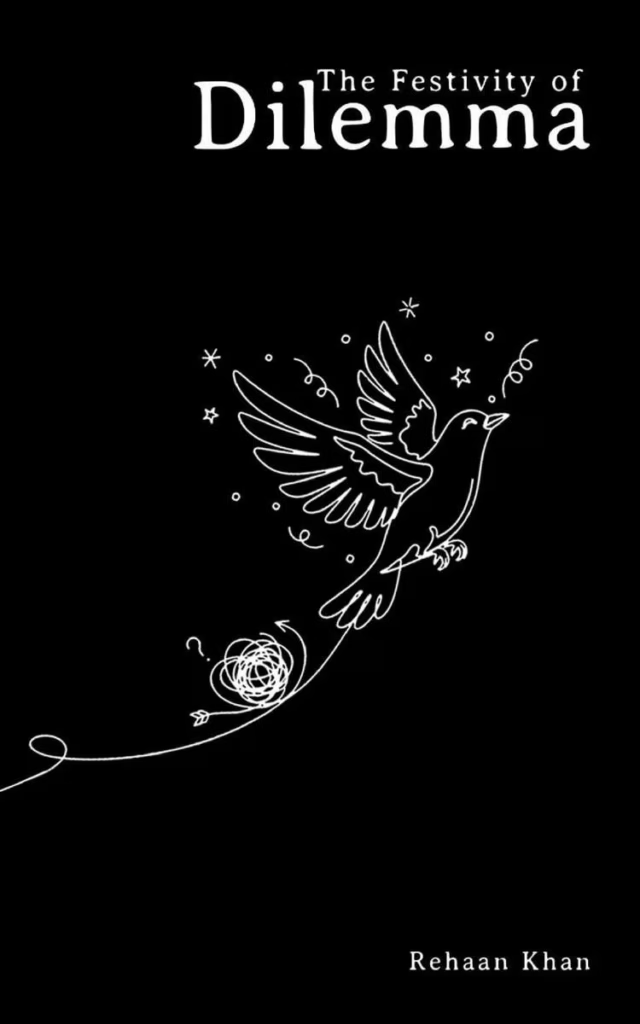
The poem “Leaves” inaugurates this theme with a poignant desire for erasure and recognition: “I want to become a leaf / Not the one attached to a bough / But the one that has fallen aground.” The fallen leaf becomes a metonym for invisibility and yet paradoxically a site of intimacy—“She keeps writing her name / On the leaves that have fallen.”This dialectic between neglect and remembrance pervades the anthology, rendering the speaker’s longing both melancholic and strangely redemptive. This existential ambivalence intensifies in “Dilemma,” where even the act of self-annihilation is subverted: “The pen superseded me / And wrote its own suicide note.” This surreal personification destabilizes agency and suggests that even despair is not wholly owned by the self. The poem is both laconic and philosophically fecund as it gestures toward an ontological crisis where intention dissolves into uncertainty.
A salient socio-political undertone surfaces in “Oh My Sahib,” a searing indictment of structural inequity. The speaker’s lamentation, “I was the one who grew the grains you eat / But I move about unfed,”is an unambiguous critique of exploitative hierarchies. The diction here is unadorned yet trenchant as it exposes the grotesque asymmetry between labor and reward. This poem, in particular, elevates the anthology from introspective lyricism to a more insurgent, almost subaltern articulation of dissent.
Mortality, however, remains the anthology’s most persistent preoccupation. “I am Going on Leave Tomorrow”is a chilling euphemism for death, rendered with an almost ceremonial serenity. Lines such as “I shall be offered wreaths / And flowers, not stones” imbue death with a perverse dignity and changes it into a final spectacle of recognition that life had denied. The poem’s extended metaphor of “leave” is both euphemistic and devastating, encompassing the speaker’s yearning for repose. Equally evocative is “Fear,” which catalogues quotidian anxieties with almost claustrophobic intensity: “I am afraid even to stand with fearlessness / To combat dread.” The recursive structure in these lines mirrors the inescapability of fear itself and produces a suffocating effect that is both visceral and cerebral.
Stylistically, the anthology oscillates between stark minimalism and lyrical expansiveness and uses metaphor with striking efficacy. The language is at times austere, at times luxuriant, yet always imbued with a certain gravitas. Words and images accrue into a palimpsest of suffering, resilience, and muted rebellion.
Finally, this anthology is an evocative work that interrogates the liminality of human existence. It explores of what it means to endure in a world rife with contradictions. However, at times the anthology’s persistent gravitation toward despair risks becoming somewhat monotonous, with limited tonal variation or moments of reprieve that could have rendered the emotional landscape more variegated and dynamically textured. A more deliberate juxtaposition of hope, irony, or even subtle resistance might have further amplified its rhetorical and aesthetic impact. Nonetheless, the anthology lingers in the reader’s consciousness, not as a resolution, but as an enduring question, one that is as disquieting as it is indispensable.
Reviewer Baral is Assistant Professor at the Central Department of English, Tribhuvan University

