

During early March of 2020, it was time for the final terminal examination for the academic year. My classmates and I’d planned to rejoice a one-month long semester break. To amplify our exultation further, there were rumors of being two-month long holidays. All of us had cheered to that rumor of holidays. It was like being on cloud-9 for middle-schoolers yet nobody knew that those very same holidays that they’d cheered upon would later go on to be a long-term lockdown caused by the contagious virus named as coronavirus. A name that has been etched to everyone’s minds and shan’t be forgotten even after biology is no longer in their set of subjects. The zoonotic virus first emerged in Wuhan city of China in early December 2019, and is believed to have two possible origins: exposure to an infected animal or a laboratory leak. It’s an infectious disease that’s mainly characterized by dry coughs, sore throat, fever and chest pain.
Covid-19 had a global impact with its effects reaching various sectors ranging from health, environment, business, education, economics and so on. It changed the way of the world. Everyone around the world had heavily been impacted while some lost their lives, some other lost their jobs and loved ones. We had the game of hide and seek with death and life. Life seemed so uncertain. Due to the constant spreading of the virus as well as the lack of sufficient number of health workers, the hospitals were tightly packed and shortages of medical supplies occurred. The everyday news of casualties, lack of oxygen and lack of cetamolols in hospitals created a great terror. We had to face the most critical time.
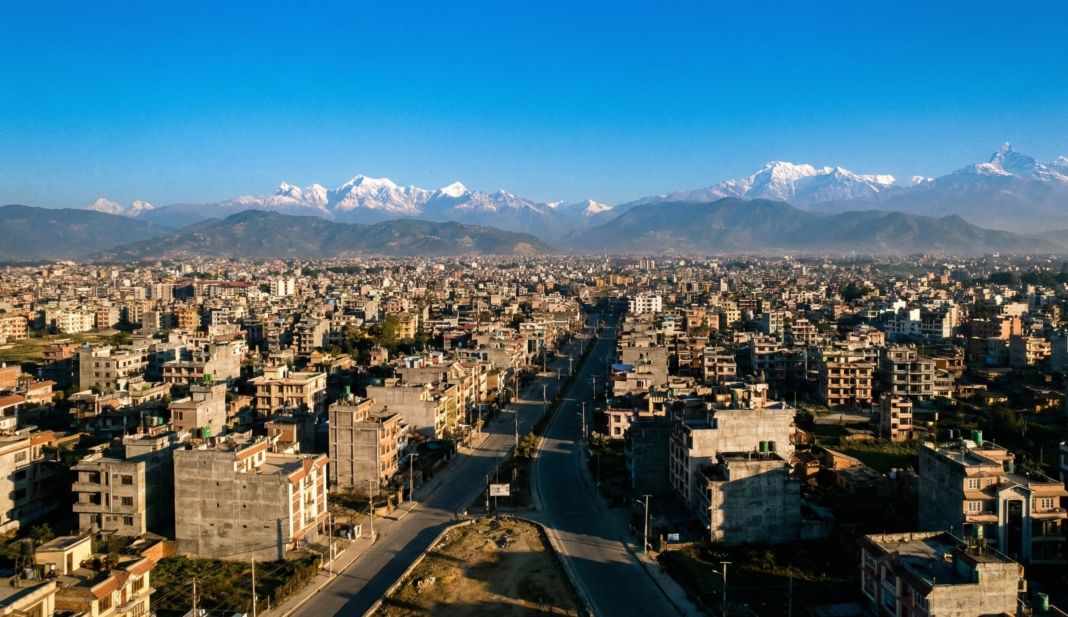
With everything closed outside due to the lockdown, the environment also seemed to have gained its life back. The dust and smoke blanketed Kathmandu valley slowly and gradually began to look clear. The pollution reduced and we had the chance to see distant mountains and hills clearly. Never before had I been able to observe the beauty of silently sitting Chandragiri and Fulchoki hills. The majestic views of those densely forested hills taught me that human is the most destructive creature. The blue pollution free sky looked as if the vast ocean it above my head. Moreover, it built the current-timeline world where technology and social media became a part of everyone’s lives.
After the constant and rapidly growing cases of Covid-19, lockdown was imposed taking into consideration of public health and safety. Due to lockdown, all public places along with schools had been closed so as to avoid the spreading of the virus. Many schools including mine own shifted to online-oriented education where students rather than going to physical school, had to attend online classes that were held mainly either via Zoom or Google Classroom. I didn’t have any experience of virtual classes before outbreak of covid. At the beginning, the online classes felt particularly odd. There were no side talks, no gossips, no noise of my mates. I was confined in my room and was being taught through my device’s screen instead of being in a classroom with my fellow classmates. It took me time to adapt and adjust in new setting. However, human beings are known for their adaptability and I, too adapted to this new foreign way of teaching and learning. Despite having been adapted to online classes, I ought to admit that it was an entirely different experience than the normal physical classes. Unlike physical classes where you can’t really avoid entering the territory of school and face-to-face meeting with people, in online classes, I had a choice of either joining the class or leaving it with a single press of the tab on my screen. It was completely up to me to decide what to do for. I’d the options displayed right on my screen. I was compelled at times to press the button to leave my class just for the feels and satisfy my rebellious instincts but shrugged off and kept my decision of attending the classes. So, in a way, the online classes did indeed serve as a test to one’s own life decisions.
As mentioned earlier, the pandemic impacted various social along with emotional. People had to go through physical distancing and social isolation which really detached them from the society and people. What can be more painful to people than isolation? Even after the lockdown, many people still haven’t fully been able to connect with the real world. People can’t seem to differentiate between real life and the gravity of the situation as they’re stuck on the virtual, fictious lifestyle they’d lived during the pandemic. I’d dare to say that the humanity of mankind has deteriorated as people are too engrossed in being content with either lazing around or embracing dopamine to understand the painful situations going around the world. They wouldn’t mind having another pandemic because they just want holidays and isolation while being either oblivious or nonchalant to the suffering and deceasing of the people across the world when it happens.
One of the most prominent changes that took place after the lockdown is the introduction to the virtual world. Computer Science and technology which once was a somewhat foreign concept has now been familiarized to everyone to the point where even young children know how to deal with gadgets. However, no one has ever been able to predict what kinds of social, emotional and psychological issues it may create in the future. The distance between children and parents, lack of interest in studies and more priority to privacy are some glimpses of technological shift. Another change that can be observed is that the pandemic also impacted the cultural events and festivals. The festivals such as Tihar and Holi which once were celebrated extensively outside homes of relatives is much lesser compared to post-pandemic. Many people either celebrate it silently or in the comfort of their home or simply don’t celebrate. People still do celebrate such events outside but it is an undeniable fact that the intensity of these bright and cheerful festivals have drastically decreased.
The pandemic now having been resolved is no longer really talked about anymore, yet the fact remains that its period of time has left its permanent impact in the world. Its exposure has taught us to face challenges and always be prepared as well as alert of our surroundings. It has taught the importance of health and physical fitness along with emotional stability.
Sayujji Subba, Grade 10

