

I am a person born into a poor family in Dolpa, and within me lies an extraordinary life story—no less than an epic. I am someone who values honesty, hard work, struggle, and family happiness above all. My home consisted of a lovely family: my grandfather, grandmother, father, mother, my younger sister, and me. Our lives moved forward peacefully—father went to the office, my sister and I attended school, and mother managed the household. Our days passed with the joy of being together, occasionally meeting with relatives—life felt like a piece of heaven.
But in early 2020, a poisonous termite named COVID-19 silently crept in from Wuhan, China, and began creating devastation. At first, we thought, “How can a virus from a corner of Wuhan reach Nepal?” But like wildfire, this virus spread rapidly and did not spare Nepal either. Gradually, the nation was engulfed, and a lockdown was imposed. Schools, offices, shops, banks, factories—everything shut down.
I had never imagined that my world could become so harsh. I began to realize that survival wasn’t enough—I had to fight, too. From March 2020, a full lockdown began. My father couldn’t go to work, my sister and I couldn’t go to school. At first, we were excited to be home all the time.
But as days turned into weeks and then months, one problem after another began piling up. Doors of hope began to shut, and dark clouds of despair hovered over us. The early morning sunrays seemed lifeless and dark. My father’s office started giving only half his salary. Debts at the grocery store grew. We struggled even to pay for our online classes and internet. Providing medicine for my grandparents—who had asthma, high blood pressure, and diabetes—became difficult, forcing us to ask for help from others.
Despite hardships, we tried to keep up with our meals, but I often saw my mother crying silently from stress. When family members fell sick, and we couldn’t even take them to the hospital, I saw my father lock himself in his room and cry uncontrollably. We had no certainty on how long we would be trapped in this cage of struggle. Death news filled social media, hospitals were overwhelmed, streets deserted—it felt like rust was eating away at our courage.
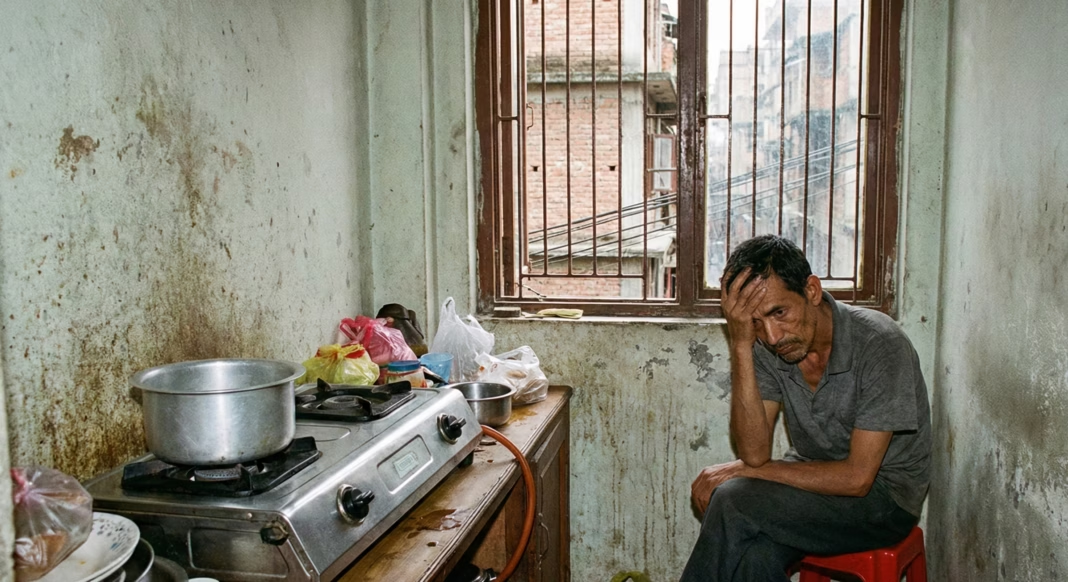
Due to the lockdown, my father had to constantly visit hospitals or clinics to find medicines for my grandparents. Sometimes there was no supply, other times the doctors simply said the stock was over. My father would return home dejected, sit quietly with a sigh on the porch, and I would see the hopeless look on his face. My grandparents would gently hold his hand and say, “Son, if we don’t get medicine, it’s okay. God will save us.” But my father knew better—how could they survive without medication? I could see him breaking inside, burning inside, but never letting his tears fall in front of his parents.
As lockdown dragged on, managing our household, paying school fees, paying bank installments—it all became almost impossible. Everything we had was used up. My father tried borrowing money from friends and relatives, but they were all in the same boat. A massive financial mountain seemed to crush our family. The lockdown had torn out a page of our lives and left it exposed—naked and helpless. I never thought time could torture so harshly. I desperately wanted to help my family in their hardship, but that felt impossible.
From a broader perspective, I realized how tiny things hold up human lives. Every morning, the sound of an empty stove froze my father’s bones. Questions like what to eat and where to find it haunted him. When my sister and I teased him about milk or meat for dinner, I could feel his heart shatter into pieces. I heard him say many times, “What a helpless father I am,” “What a powerless husband.” These words deeply wounded my heart, but I also knew this was not his fault—it was the game of circumstance, and I had to accept it.
Meanwhile, COVID became more aggressive. News of hospital crowding, oxygen shortages, and body piles at cremation grounds took away my sleep. I was constantly terrified—what if my family got infected? What if my
sick grandparents needed hospitalization? What if the pillar of our family—my father—got COVID? What would happen to us? These thoughts played in my mind like a movie. Many nights I silently cried, my weak body burdened by tears.
The pandemic locked everyone in their homes. Seeing the same faces every day, sharing the same fears, anger, frustration—our emotions boiled to the surface. When my mother got angry or we quarreled, my grandparents muttered, “We’ve never experienced this before. What has come upon us?” My father tried to mediate calmly,
even when his voice cracked. His ability to hide his tears and offer comfort made me realize that strength sometimes looks like silence.
Despite all our prayers, disaster struck. My father got infected with COVID. It turned into pneumonia, and he was hospitalized for months. The pillar of our family had fallen. Our only means of survival was gone. Nobody could bring medicine for my grandparents. There were days when our stove did not burn. We went door-to door, to neighbors, microfinance groups, cooperatives—trying to collect funds for treatment, but always returned empty-handed. Everyone was broke.
While staying at the hospital with my father, I kept thinking—disease, hunger, and poverty are mankind’s greatest enemies. These alone can make anyone kneel. My grandparents, being traditional, believed in fate and religion. Every morning and evening, they sat before God’s image and cried, “Please save our son.” I often wondered—was God listening? Their trembling hands and tearful eyes broke me. At that point, all technology, money, and power seemed meaningless. Yet, their prayers somehow gave me strength.
Pain echoed in every home. Farmers couldn’t get seeds and fertilizers. People starved. Hospitals were far, medicine was scarce, loneliness rampant. The pandemic devastated both villages and cities. It was unbearable. I used to sit in a hospital corner and cry where no one could see me. Even doctors and nurses were afraid to approach my father. When he finally defeated COVID and returned home, the villagers were even more afraid. They avoided us, scared to enter our home.
The lockdown shattered the dreams of countless children like me. Schools and colleges were closed. Online learning was impossible for many with weak internet or no experience. Our phone screens often froze. I often wondered—how will our dreams survive through all this?
My father used to hold me and my sister and say, “In your eyes, I see tomorrow’s dreams. Even if lockdown takes away many things, I’ll never let your dreams die.” I wanted to be a pilot. My sister wanted to be a doctor. He once told us that he, too, had dreamt of becoming a bank manager, but poverty had crushed those dreams like a house of cards. This terrified me—would our dreams also vanish?
But he’d hold our hands and say, “Even if I failed, I’ll never let your dreams rot.” His words often brought tears to my eyes. I used to say, “Once I become a pilot, I’ll go abroad and make you proud.” He’d smile and say, “Son, the world is uncertain. Who knows what happens when children go abroad? But I’ll never stop your dreams.” I felt so proud—my father was our pillar, our foundation.
My grandparents, too, relied entirely on my father. Their faces were pale and tired due to the crisis. Doctor checkups were stopped, and medicines were inconsistent. One day, my grandfather held my hand and said, “Son, we are living because of you now. Protect us.” His words overwhelmed me. Tears filled my eyes. I promised myself—I will never let down their trust. I will protect my family’s dreams, at any cost.
Everywhere I looked—there was despair. Businesses failed. Factories closed. Jobs were lost. Children’s education interrupted. Years of hard work vanished. People lost loved ones. Some looked like travelers with no destination, some seemed mentally broken. I reminded myself—don’t give up, rise up. I started seeing a silver lining behind the dark clouds.
During our hungriest days, one neighbor shared rice and lentils with us, saying, “Let’s share what we have.” That simple act of kindness melted me. I couldn’t stop my tears. I realized—when everything fails, people are each other’s strongest support.
Months later, the lockdown eased. My father resumed work, and our school reopened. Everything was under strict rules. Social distancing, masks, handwashing—it felt like a new version of life. Even though the world reopened, people’s minds remained closed. Fear lingered. Even a mild cough scared us. I realized—COVID’s deepest wounds were not in the body, but in the soul and psyche.
The pandemic taught us many lessons. Anger, pride, and fights are meaningless. Life is uncertain. Even distant relatives reconnected. Many hearts softened, many bonds healed. Our neighbor who once walked past us silently became a lifesaver. We learned that this warmth and kindness must live on beyond the pandemic.
Just because lockdowns eased didn’t mean lives returned to normal. The economy remained weak. Unemployment and poverty still loomed. Hospitals remained crowded. My father still worked for half-pay. And the fears of a second wave haunted us. What if the virus returned? What if father lost his job again? What about our future?
So many nights, I couldn’t sleep. I stood alone at midnight in our yard, staring at the sky, wondering. But one thing I remember clearly—my mother stood strong through it all. She became our family’s unshakable pillar. An educated housewife with more mental strength than father himself, she used to say, “If we survive, we can
rebuild.” Every morning, with a smile, she cooked whatever we had and gave us energy. Father used to say, “The backbone of this house is my wife.” Her courage lifted all of us.
COVID changed our society’s thinking. Hygiene, compassion, humanity—these became important. People started respecting healthcare workers more. Village-city relationships improved. Though the world suffered greatly, it also learned powerful lessons.
For me, COVID left behind a deep, unforgettable mark. Life never goes as planned. Storms can hit anytime. But with sympathy, kindness, and love—we can overcome anything. This pandemic taught me: you don’t need wealth to conquer the world—just courage, support, and love.

